Spain is known for having one of the strongest healthcare systems in Europe, but for international residents, the real question is not simply: “Is Spanish healthcare good?” The better question is: which type of healthcare can you actually access — and which one makes sense for your situation?
Spain has both a public healthcare system and a strong private healthcare sector. Public healthcare is high quality and affordable for those who are eligible, while private health insurance is often the fastest and most practical option for expats, students, digital nomads, retirees and visa applicants.
Here is an honest comparison of both.
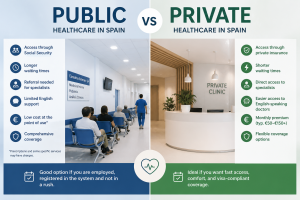
Public vs Private Healthcare in Spain: Quick Comparison
How Public Healthcare Works in Spain
Spain’s public healthcare system is called the Sistema Nacional de Salud (SNS). It provides access to primary care, specialist care, hospital treatment and emergency care. For those who are eligible, services are largely provided without direct charges at the point of use, except for prescriptions and some specific services.
Public healthcare is usually available to people who are working in Spain and paying into Social Security, self-employed residents who contribute to the system, pensioners with recognised rights, and certain legal residents depending on their situation. However, for many newcomers, especially non-EU citizens arriving on visas, access may not be immediate.
This is where many international residents get confused. Moving to Spain does not automatically mean you can use the public system from day one. Your eligibility depends on your legal status, employment situation, Social Security registration and sometimes regional procedures.
Strengths of Public Healthcare
The biggest advantage of public healthcare in Spain is that it is comprehensive and affordable once you qualify. It is especially strong for emergencies, hospital care, serious conditions and long-term medical needs.
For residents who are already settled, employed or properly registered, the public system can be more than enough for many healthcare needs.
Weaknesses of Public Healthcare
The main challenge is access and waiting time. Public healthcare is not always immediate for newcomers, and waiting times for non-urgent appointments or specialists can be longer. Language can also be an issue, because English-speaking doctors are not guaranteed.
For foreign residents who have just arrived, need quick access, or are still applying for residency, relying only on the public system can be limiting.
How Private Healthcare Works in Spain
Private healthcare in Spain works through a private health insurance policy. You choose a plan, receive your insurance documents and medical card, and then use the insurer’s medical network to book appointments with doctors, specialists, clinics and hospitals.
With Insbrok/Gidea health plans, clients can choose specialists from the medical directory, book directly, show their health card and ID at the clinic, and the insurer pays the medical provider directly. This means clients are not normally asked to pay upfront for covered services.
Private health insurance is especially common among international residents because it offers faster access, more flexibility, and easier access to English-speaking support. It typically includes direct access to specialists, shorter waiting times, and coverage from the first day of the policy.
It’s essential to know that while obtaining a private health insurance might be easier, it is as well not always guaranteed.
You can compare visa-compliant health insurance options here.
How Much Does Private Health Insurance Cost in Spain?

The cost depends on age, provider, coverage level and medical history. As a general guide, private health insurance in Spain typically costs €50–€150 per month for younger to middle-aged adults, with higher premiums for older applicants (which can reach €300/month or more depending on age and coverage).
For students, prices may be lower, often around €40–€100 per month, depending on the policy and requirements.
Why Private Insurance Matters for Visa Applicants
For many Spanish visa and residency applications, private health insurance is not just helpful — it is required. This is especially important for non-EU citizens applying for visas such as non-lucrative visas, student visas, digital nomad visas or other residency permits.
Visa-compliant insurance must typically include full coverage, no co-payments, no deductibles and coverage across Spain. Insbrok’s health insurance options are designed to meet these requirements and are widely used for residency applications.
Do You Need Both Public and Private Healthcare?
Sometimes, yes.
Many international residents start with private insurance because it is required for their visa or because they are not yet eligible for public healthcare. Later, once they become employed, registered and eligible for the public system, they may continue using private insurance for faster appointments, English-speaking doctors and direct specialist access.
This dual approach is common: public healthcare for major or long-term needs, and private healthcare for speed, comfort and convenience.
When Public Healthcare May Be Enough
Public healthcare may be enough if you are already employed in Spain, registered with Social Security, legally entitled to public healthcare, and comfortable using the Spanish system.
It can also make sense if you speak Spanish well, do not mind waiting for non-urgent appointments, and do not need private hospitals or English-speaking support.
When Private Healthcare Makes More Sense
Private healthcare is usually the better option if you are applying for a visa, just moved to Spain, want fast access to specialists, need English-speaking support, or are not yet eligible for the public system.
It is also a strong option for people who want more control over their healthcare experience, especially during the first months after moving.
Honest Recommendation

There is no single “best” option for everyone.
If you are already settled, working in Spain and registered in the public system, public healthcare may cover most of your needs. But if you are applying for a visa, moving to Spain for the first time, studying, retiring, or working remotely, private health insurance is usually the safest and most practical starting point.
For most international residents, the best approach is simple:
Need a visa? → Choose private insurance
Want speed & English support? → Choose private insurance
Already employed and registered? → Public may be enough (with private as an option)
Not sure what applies to you?
Get your free quote in 24h and compare visa-compliant health insurance options.
FAQ
Is public healthcare free in Spain?
For eligible individuals, most services are provided without direct charges at the point of use. However, prescriptions and some specific services may require a contribution.
Can foreign residents use public healthcare in Spain?
Some can, but not everyone can access it immediately. Access depends on employment, Social Security contributions, legal residence status and other entitlement rules.
Do I need private health insurance for a Spanish visa?
For many visa and residency applications, yes. The policy usually needs to provide full coverage, with no co-payments, no deductibles and no coverage limits.
Can I use private insurance from the first day?
Not normally, waiting periods apply but, Gidea policies allow you to access healthcare from the first day the policy becomes active.
Do private doctors in Spain speak English?
Not all of them, but it is generally easier to find English-speaking doctors through private healthcare than through the public system.
Is private healthcare better than public healthcare in Spain?
Not necessarily better — just different. Public healthcare is strong and comprehensive, while private healthcare is usually faster, more flexible and easier to access for international residents.
Not sure what’s right for you? Get your free quote in 24h and compare your options.


Leave a Reply