Private health insurance in Spain is essential for expats — especially if you’re applying for a visa or moving long-term.
If you’re researching private health insurance Spain, you’ll quickly notice that it’s not just about coverage — it’s often a legal requirement. The right policy must meet strict conditions like full coverage, no co-payments, and immediate access to healthcare.
Most expats pay between €50 and €350 per month, depending on age and provider — younger applicants (under 40) often start around €50, while applicants over 60 typically pay €150–€350. Here’s everything you need to know before choosing a plan.
📘 Ready to get a quote? See our health insurance for expats in Spain page to compare visa-compliant plans from our partner insurers.

What is private health insurance in Spain?
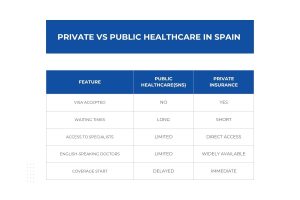
Private health insurance in Spain gives you fast access to doctors, specialists, and hospitals without waiting times.
Unlike the public system, private insurance allows you to:
- Book appointments directly with specialists
- Access English-speaking doctors
- Avoid long waiting lists
- Choose your clinic and doctor from a national network
- Receive treatment in modern private hospitals
You’ll receive a medical card and can visit any provider within your insurer’s network. In most cases, the clinic bills the insurer directly — you don’t pay upfront.
Spain also has one of Europe’s most efficient private healthcare sectors. Diagnostic appointments typically happen within days rather than weeks, specialist referrals are rarely required, and most major cities have hospitals staffed by English-speaking doctors within every brokered insurer’s network.
Who needs private health insurance in Spain — and who doesn’t?
Whether you need private health insurance depends on your residency status and visa type.
You need private insurance if you are:
- A non-EU citizen applying for any long-stay visa (Non-Lucrative, Digital Nomad, Student, or renewing a Golden Visa)
- An EU citizen who isn’t employed or self-employed in Spain and therefore can’t access the public system (SNS)
- A remote worker whose home-country insurance doesn’t cover Spain or isn’t DGSFP-registered
- A retiree moving to Spain before you’re eligible for any EU healthcare agreement (UK S1, for example)
You might not need it if you are:
- Employed by a Spanish company and paying into Spanish social security (you get SNS access automatically)
- Self-employed (autónomo) and paying social security contributions
- A UK retiree with a valid S1 form (entitles you to SNS access)
- Covered by a convenio especial arrangement after one year of residence (~€60–€157 per month for public system access)
Even when public healthcare is available to you, many expats and Spanish citizens still choose private insurance for shorter waiting times and direct access to English-speaking specialists. It’s common to hold both, using private for day-to-day care and public for major procedures.
Do you need private health insurance for a Spain visa?
Yes — private health insurance is mandatory for most Spanish visa applications, including the Digital Nomad Visa, Non-Lucrative Visa, Student Visa, and residence permit renewals.
If you’re a non-EU citizen or not employed in Spain, you must provide proof of private health coverage.
All visa-compliant policies must:
- Cover the entire Spanish territory
- Match public healthcare coverage
- Be valid for the full duration of your stay
- Be issued by an insurer authorised by Spain’s DGSFP (Dirección General de Seguros y Fondos de Pensiones)
Insbrok policies are 100% compatible with Spanish residency and visa applications.
What must private health insurance in Spain include?
To be accepted for a visa, your insurance must provide full, comprehensive coverage with no gaps.
Spanish authorities typically require:
- No co-payments
- No deductibles
- Full coverage (hospitalisation, outpatient care, diagnostics, aftercare)
- No waiting periods for medical services required for visa compliance
- No monetary coverage cap
- Policy duration covering the full visa validity period
This ensures you can access healthcare from day one.
International-only policies are a common pitfall. Plans like Cigna Global are not DGSFP-registered and are routinely rejected by Spanish consulates, regardless of how comprehensive their coverage looks on paper. Travel insurance doesn’t qualify either — only full private health insurance from a Spanish-authorised insurer.
How much does private health insurance cost in Spain?
Private health insurance in Spain typically costs between €50 and €350 per month for a visa-compliant policy with no co-payments.
Cost depends on three main factors:
- Age — premiums rise gradually from 30 and increase significantly after 60. Some insurers stop accepting new applicants after 65–70
- Provider — Sanitas, DKV, Adeslas, Asisa and Salus all offer visa-compliant plans with slightly different price structures
- Coverage level — basic plans start lower; reimbursement plans with international flexibility cost 2–3× more
Typical cost ranges by age
The table below shows approximate monthly premium ranges for a standard no-copayment visa-compliant plan. Your exact quote will vary by insurer and chosen coverage tier — request a free quote to see real numbers for your situation.
| Age group | Typical monthly premium | Notes |
|---|---|---|
| Under 30 | €45 – €80 | Most affordable bracket; all insurers accept |
| 30 – 45 | €55 – €110 | Small year-on-year increases |
| 45 – 60 | €90 – €180 | Premiums rise more steeply from 55 |
| 60 – 69 | €150 – €280 | Some insurers require additional medical disclosure |
| 70+ | €250 – €350+ | Not all insurers accept new applicants; options narrower |
For visa applications, upfront annual payment is typically required — especially if you don’t yet have a Spanish bank account. Sanitas and DKV in particular ask for the full year upfront before the visa appointment.
Top health insurance providers compared
All five insurers brokered by Insbrok offer DGSFP-authorised, visa-compliant plans. The table below summarises what each is best known for.
| Provider | Known for | Network | Best for |
|---|---|---|---|
| Sanitas | Quality hospitals, strong brand, part of Bupa | Owned hospitals + wide network nationwide | Expats who want premium private hospitals |
| DKV | Strong English-language support, German insurer | Extensive Spanish network | English-speaking expats prioritising service |
| Adeslas | Spain’s largest health insurer | Largest medical network in the country | Widest choice of doctors and hospitals |
| Asisa | Medical-professional cooperative, balanced pricing | Nationwide including Balearic and Canary Islands | Families and long-term residents |
| Salus | Full visa compliance, competitive entry pricing | Growing network, strong on cost | Budget-conscious visa applicants |
Choosing between them often comes down to whether your priority is network size, language support, or price. A broker can match you based on your city, age, and needs in a single quote request.
What happens if your visa is rejected?
Once the insurance certificate is issued, the policy is active and generally non-cancellable and non-refundable.
In case of a final visa denial, a partial refund (up to 75%) may be considered if official proof is provided and no further action (appeal/review) is taken, while full refunds are not available.
All cases are reviewed individually, and any exceptions are granted only at discretion.
Are pre-existing conditions covered?
In most cases, pre-existing conditions are excluded — but there are exceptions.
- Most insurers do not cover them automatically
- Some insurers offer plans that cover certain pre-existing conditions — ask your broker
- You must complete a health questionnaire honestly
Incorrect information on the health questionnaire can result in policy cancellation or denied claims. Disclose fully — insurers often accept applicants with managed conditions at standard rates or with small surcharges.
Documents needed to apply
Applying for private health insurance in Spain is straightforward. You typically need:
- Passport copy for each person to be insured
- Completed health questionnaire (online form) for each applicant
- Payment method — credit card or IBAN for direct debit (Spanish bank account not always required for first-year upfront payment)
- NIE number if you already have one; not required to start the application
- Proof of address (your Spanish or home-country address is accepted)
You do not need to be physically in Spain to apply. Most policies can be set up entirely online and issued before you travel, which is important when the insurance certificate has to be submitted with your visa application at a Spanish consulate.
How to apply step-by-step
The full application process typically takes between 2 and 7 working days from first quote to issued certificate:
- Request a quote — fill in a short form with age, destination, coverage needs. A broker returns comparison quotes from multiple insurers
- Compare options — look at monthly premium, network, language support, and whether upfront annual payment is required
- Complete the health questionnaire for each insured person
- Provide passport copies and confirm the start date
- Pay the first premium (monthly or annual depending on the insurer and whether it’s for a visa)
- Receive the insurance certificate — this is the document you submit with your visa application
- Receive your medical card shortly after, giving access to the insurer’s network from the start date
How does private health insurance in Spain work?
Using private health insurance in Spain is simple and typically cash-free.
Here’s how it works:
- Choose a doctor or clinic from your insurer’s directory
- Book an appointment directly
- Show your health insurance card
- The provider bills the insurer directly
You won’t be asked to pay when receiving care. Some specialist appointments or complex diagnostics may require pre-authorisation from the insurer — a quick phone call or app request that’s typically approved within 24 hours.
🎥 Watch: How health insurance works for expats in Spain
This video explains key aspects of private health insurance in Spain, including coverage options and how to book medical appointments.
Common mistakes expats make when choosing insurance
Choosing the wrong policy can delay your visa or leave you uninsured.
Avoid these mistakes:
- Choosing travel insurance instead of private insurance
- Selecting a plan with co-payments
- Choosing international insurance (e.g. Cigna Global) that isn’t registered with Spain’s DGSFP — consulates will reject it
- Not checking visa compliance before paying
- Ignoring pre-existing condition exclusions
- Not paying upfront for visa applications when required
- Leaving the application until the last week before your consulate appointment
When to buy: timing your application
Timing matters more than most applicants realise. Consulates typically require that your policy start date sits within a tight window — often no earlier than 30 days before your stated arrival date in Spain.
A good rule of thumb:
- Start comparing quotes 6–8 weeks before your consulate appointment
- Finalise and pay for the policy 2–3 weeks before the appointment
- Set the policy start date to match your planned Spain arrival date (or slightly before — not weeks early)
Paying too early can mean “wasted” months of coverage before you arrive. Paying too late means you might not have the certificate in hand when the consulate asks for it. A broker experienced with visa-timing can align these dates for you automatically.
Frequently Asked Questions
Do I need private health insurance in Spain?
Yes, especially if you’re applying for a visa or you’re not eligible for public healthcare through employment or social security contributions.
Can I use my insurance immediately?
Yes — most policies allow access to doctors from day one. Some services like maternity care, oncology, or major surgery may have waiting periods of 6–10 months depending on the insurer.
Can I buy insurance before arriving in Spain?
Yes. You can apply online from anywhere in the world. In fact, you usually have to — the consulate requires the insurance certificate as part of your visa application, before you travel.
Do I need a Spanish bank account?
No — you can pay by transfer or card initially. However, some insurers (notably Sanitas and DKV) require upfront annual payment if you don’t have a Spanish account. Adeslas and Asisa are typically more flexible on this.
Can I see a specialist without a referral?
Yes, in most cases you can book directly without a GP referral, which is a major advantage over the public system.
How long are contracts?
Most health insurance policies in Spain have a minimum duration of 1 year. After the first year, you can usually cancel with 30 days’ written notice before each renewal date.
Is private health insurance tax-deductible in Spain?
Partially — if you’re self-employed (autónomo), you can deduct up to €500 per person per year (€1,500 for disabled persons) from your IRPF tax. The deduction applies to you, your spouse, and dependent children.
What if I want to switch insurers later?
You can switch at each renewal with 30 days’ notice. New insurers will usually not cover pre-existing conditions that arose during your previous policy, so consider timing and health status before changing.
Does private insurance cover prescriptions?
In most cases no — private plans cover the cost of consultations and hospital procedures, but prescription medications from pharmacies are usually paid out of pocket. Only medications administered during hospital stays are covered by the insurance.
Can my family be added to the policy?
Yes. Spouse and children can typically be added either to the same policy or as linked policies with a family discount, which reduces the per-person monthly cost. Each family member completes their own health questionnaire.
Get Covered Before You Move
Choosing the right private health insurance in Spain is one of the most important steps when relocating — and getting it wrong can delay your visa or cost you time and money.
With years of experience helping expats, Insbrok compares providers and finds the best option for your situation.
Get a free quote at insbrok.com


Leave a Reply